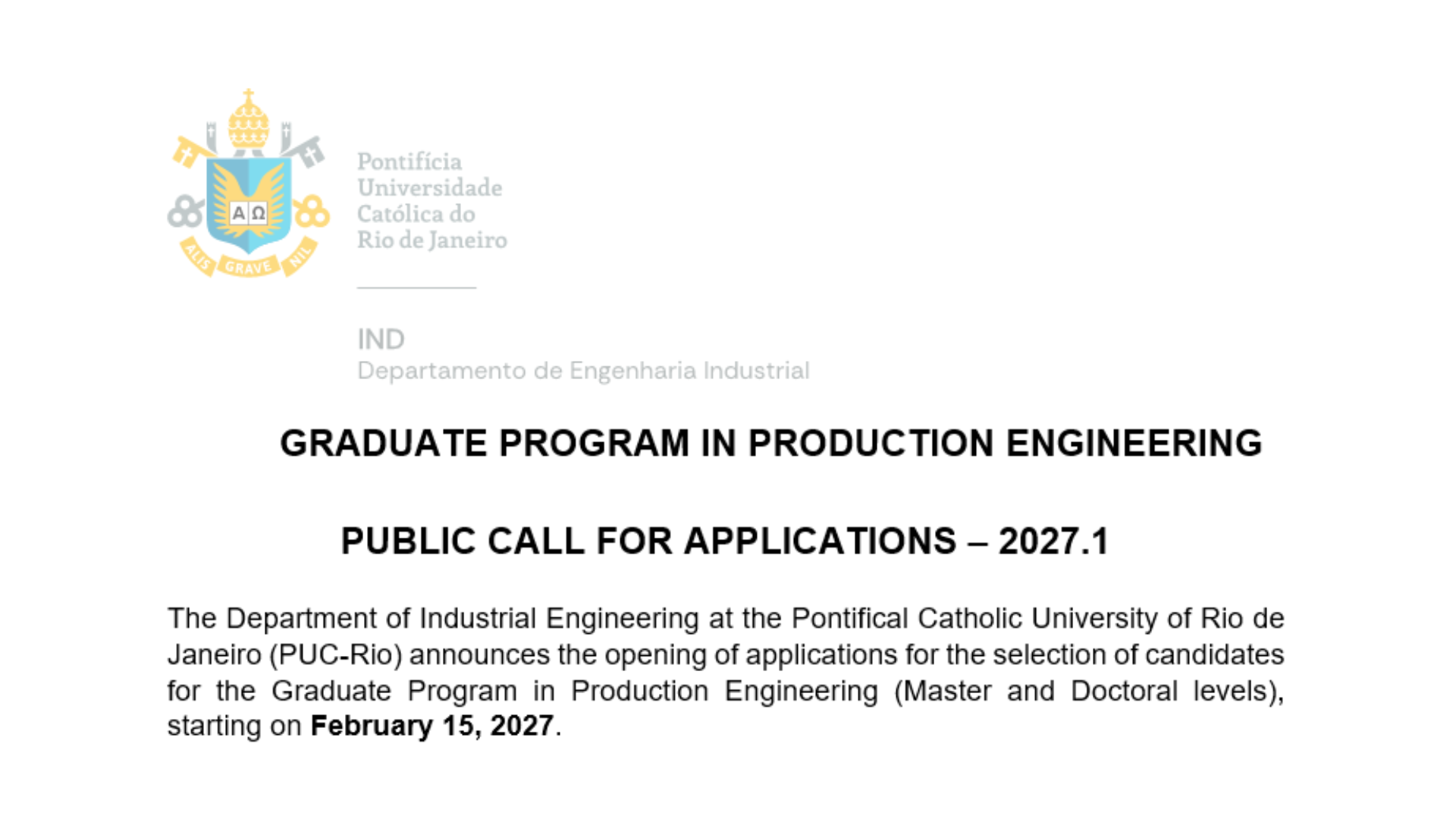
2027.1 Admissions – Master’s and Doctoral Programs in Industrial Engineering
The admissions process also includes an Affirmative Action Policy, with reserved places for Black applicants, Indigenous applicants, individuals experiencing socioeconomic vulnerability, persons with disabilities, refugees, and applicants eligible under the Priority Regional Inclusion policy.
📄
Read the full public call.
📅 Key information
- Application deadline: 8 November 2026
- Classes begin: 15 February 2027
- Programs: Master’s and Doctoral Programs in Industrial Engineering
- Available places: up to 15 for the Master’s Program and up to 15 for the Doctoral Program
- Apply: PUC-Rio Academic Application System
🤝 Affirmative Action Policy
- 30% of the places will be reserved for applicants belonging to groups covered by the quota policy.
- One place is specifically reserved for persons with disabilities.
- The Program will reserve one scholarship for applicants admitted through Affirmative Action and/or Priority Regional Inclusion, subject to budget availability.
- Applicants must select only one quota group in the application form.
📎 Required documents
- Two reference letters submitted online through the application system
- Curriculum Vitae, preferably from the Lattes Platform
- Study Plan
- Academic transcripts
- Diploma or certificate of completion
- Birth or Marriage Certificate
- Specific documents for employed applicants, where applicable
- For the Doctoral Program: a Research Plan signed by the prospective supervisor
Course Presentation
The Program tries to transmit a solid formation to its students, which is necessary for a continuous and permanent professional and academic development. For this purpose, it renders a learning and research orientation that emphasizes the analytical and quantitative study of productive systems. Along the studies, the student acquires a solid base in microeconomics, statistic methods, mathematic modeling and computer utilization, and also develops the initial habilitation to use them in the analysis and project of productive systems. According to the specialization line, an operational understanding of organization theories, of fundamental aspects of productive systems, of production technology evolution, of capital market mechanisms and the necessary economic criteria to fundament financial decisions or of transport and logistic systems is also required.
The research looks for an academic excellence line in the investigation of problems, which are relevant for the technical management development of Brazilian companies. The involvement of students with the research, as well as the collaboration of companies in this activity is considered not only as a formation demand and of the research pragmatic quality, but also the most important updated and adapted knowledge divulgation vehicle, be it original or acquired from other sources.
PROGRAM EVALUATION
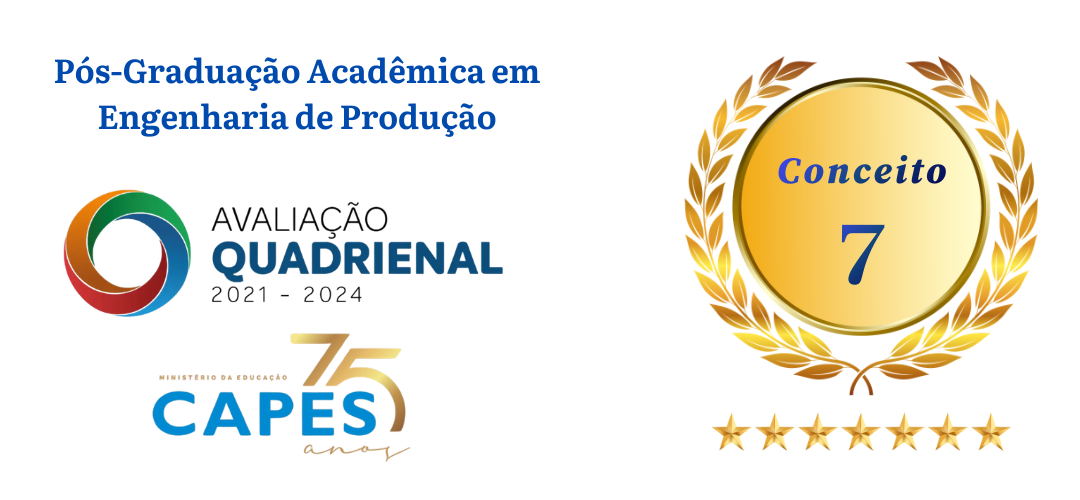
The Industrial Engineering Department of the Pontifical Catholic University of Rio de Janeiro (DEI/PUC/Rio) started its activities in 1967, with the creation of the first Master Degree Program in Production Engineering of Brazil. In 1993, the DEI/PUC/Rio implemented its Production Engineering Doctorate Program, which was immediately recommended by CAPES. In 2001, attending the increasing demand for professionals with technical formation to act in the logistic management, the DEI/PUC/Rio created the Professional Master Degree in Logistic. In the last evaluation, the Area Committee (ENGINEERING III) and the Scientific Technical Council of CAPES rendered the grade 7 (seven) to the Academic Master and Doctorate Programs, and they were placed among the three best of the country and the first in the southeast region.
INTERNATIONALIZATION
Through the Central Coordination for International Cooperation (CCCI), PUC-Rio has a support program to welcome foreign students and researchers.
Mission
“Train highly qualified masters and doctoral graduates in the field of Production Engineering, capable of meeting current and future societal demands, while generating intellectual output and technologies of high impact and relevance to both Brazilian and international communities.”
Vision
“To be recognized, at national and international levels, as a center of excellence for teaching, research and innovation in Production Engineering and related areas.”
Areas
Offered Courses
- Masters Degree in Production Engineering – Click here to apply
- Doctoral Degree in Production Engineering – Click here to apply